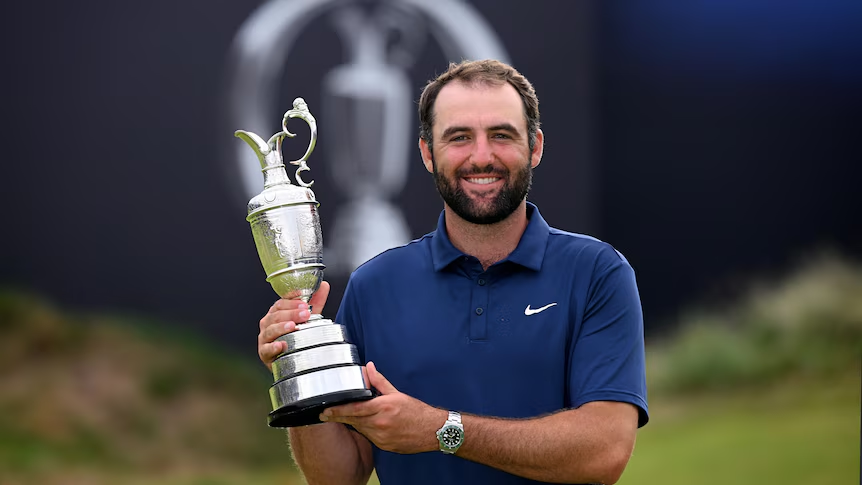
The 2025 major season exploded onto the scene with unforgettable drama but concluded quietly amid the windswept dunes of Royal Portrush. After Rory McIlroy’s electrifying back-and-forth victory at Augusta, expectations soared for more fireworks at the year’s final major, especially with it being staged in his home country of Northern Ireland. However, instead of tempestuous weather and nail-biting finishes, smooth, sunny conditions greeted Scottie Scheffler as he powered to a commanding four-stroke victory. His near-flawless 64 in the second round set the tone, and his steady, disciplined play throughout the week firmly established him among the sport’s elite, positioning him ever closer to an almost inevitable career Grand Slam. Meanwhile, Rory settled for a composed top-10 finish, leaving himself just one major shy of equaling Europe’s modern record, a reminder that even amid great achievement, there are still chapters left to write.
Reflecting on my pre-tournament picks, I had confidence in a few players who unfortunately didn’t quite deliver as expected. Viktor Hovland, a +3000 long shot for the title, faltered with rounds of 73, 69, 73, and 73, finishing tied for 63rd—his ball-striking inconsistency on the demanding Royal Portrush layout costing him dearly. Similarly, Sepp Straka, who I backed to finish inside the top 20 at +180, came up short with steady but unspectacular rounds of 72, 71, 70, and 71, ultimately tied for 52nd. His cautious approach on Sunday, marked by 18 pars and a lack of birdies, showed a conservative strategy that failed to translate into significant upward movement on the leaderboard. On the brighter side, my faith in Xander Schauffele paid dividends as he posted solid rounds of 71, 69, 66, and 68, securing a well-earned tie for seventh place and proving the value of steady, adaptable play under major championship pressure. Schauffele’s ability to improve round by round demonstrated the importance of consistency and mental toughness when the stakes are highest.
Scottie Scheffler’s performance at Royal Portrush was a masterclass in precision, control, and championship-level golf. From his very first tee shot on Thursday to the final putt on Sunday, he appeared locked in, unfazed by the swirling pressure that often rattles even the best players in major championships. Scheffler approached every hole with clear intention, never overextending but always capitalizing on scoring opportunities, particularly on the scorable par-5s and the shorter par-4s where his game shone brightest. In a venue known for producing chaos, Scheffler neutralized Royal Portrush’s challenges by keeping the ball in play, hitting an impressive number of greens in regulation, and trusting his putter to finish the job. His four-stroke victory wasn’t the result of a single spectacular round but four consecutive days of elite ball-striking and unwavering mental poise, which left no doubt as to who was the world’s best player that week. The calm, calculated manner in which he dismantled the field—especially as conditions evolved over the weekend—set him apart, as he avoided the costly risks that derailed many of his closest challengers.
While others succumbed to bogeys and double bogeys, Scheffler stuck to a disciplined game plan, steering clear of the big mistakes that often define major championship Sundays. His win wasn’t built on miraculous recoveries or streaky putting but on precision, patience, and unshakable confidence. When pressure moments arose—whether it was a mid-round charge from a playing partner or a difficult up-and-down to save par—Scheffler handled them with the composure of a multiple major winner. His closing round of 68 was a model of smooth, straightforward golf, lacking drama but full of entertaining, methodical play that maintained his lead while the rest of the field faltered. With this victory, Scheffler secured the third leg of his career Grand Slam, joining an elite group of players who have claimed the Masters, PGA Championship, and The Open. His name now comfortably sits alongside the game’s legends, and with his recent consistency, the missing U.S. Open title feels more like a question of when rather than if. Over the past three seasons, no player has matched his week-to-week brilliance, and his performance at Portrush was further proof of a generational talent in full bloom. As others chase fleeting moments, Scheffler quietly continues to build a legacy that feels increasingly inevitable.
Rory McIlroy also made a strong statement at the Open, delivering a redemptive and emotionally charged performance on a course that had once haunted him. Overcoming the weight of national expectations and the sting of a missed cut in 2019, Rory showed maturity and composure throughout the week, finishing in the top 10 to the delight of the home crowd. He carried both momentum and pressure into Northern Ireland, where fans greeted him with raucous support and high hopes for a fairytale repeat. Rather than pressing for early magic, Rory played thoughtful, steady golf, demonstrating the kind of shot selection and course management that have defined much of his major success. His driving was precise, setting up advantageous positions on a relatively soft, forgiving layout that demanded accuracy more than sheer power. While his putting cooled at times and he never mounted a serious Sunday charge to catch Scheffler, Rory’s ability to remain calm and in striking distance throughout the week reflected significant emotional growth and competitive resilience.
What stood out most during the week was Rory’s calm focus—a man playing for something deeper than just a trophy. He sought redemption, closure, and a connection to his roots amidst the fervent Irish crowd. His iron play was sharp and dependable, especially from longer distances where he consistently created birdie opportunities, though he didn’t convert enough to truly threaten Scheffler’s dominance. Rory’s patient navigation of the inward nine, particularly holes 16 and 17, showcased his strategic maturity and ability to avoid mental pitfalls that have plagued him in past Opens. Though he fell short of a dramatic surge, his steady play kept him close to contention and confirmed his game remains world-class from tee to green. More importantly, Rory seemed at peace with the challenge, competing with a quiet intensity that suggested his pursuit of a sixth major is as much about embracing the journey as it is about the prize itself. His performance was a powerful reminder that while he didn’t lift the Claret Jug this time, his confidence, form, and legacy remain on an upward trajectory.
Like I mentioned before, Xander Schauffele once again drew plenty of attention, aiming to become the first player since Padraig Harrington to win back-to-back Claret Jugs. Though he fell short of victory, Schauffele delivered another solid and composed performance, arriving with momentum and quiet confidence that carried him through all four rounds. His ball-striking was reliable, and he demonstrated particular skill navigating the subtle slopes and tight run-off areas that define Royal Portrush, rarely putting himself in trouble even as scoring grew difficult for others. While he never seriously threatened Scheffler on Sunday, Schauffele remained within reach of the leaderboard, grinding out pars and capitalizing on scoring chances with patience and poise. His final-round 68—one of the day’s better scores—helped him secure a tie for seventh, marking his second consecutive top-10 at the Open and underscoring his consistency and mental resilience. Still, the absence of a truly dominant round left the sense that he is chasing that elusive breakthrough to claim one of golf’s toughest titles.
Bryson DeChambeau’s week was a rollercoaster of resilience and renewed belief in his ability on links-style courses. He stumbled out of the gate with a disastrous 78 in the opening round, struggling to find fairways, battling thick rough, and unable to buy a putt—putting him in serious danger of missing the cut. Yet true to form, he responded with a blistering 65 on Friday, a round marked by bold tee shots, precise irons, and a fiery intensity that matched the urgency of his situation. That second-round surge propelled him into the weekend, sparking momentum that he carried with steady, strategic play over Saturday and Sunday’s calmer conditions. A final-round 64 catapulted him into a tie for tenth, a testament to his adaptability and mental toughness and proof that one bad round is not the end of the world in any tournament. DeChambeau’s performance reminded fans and critics alike that while his power grabs headlines, it’s his evolving maturity and willingness to adjust that may soon make him a consistent major threat worldwide.
One of the more quietly captivating stories of the week was the almost eerie twin rivalry between Nicolai and Rasmus Højgaard, who hovered near each other on the leaderboard throughout the championship. Nicolai delivered an impressive display of consistency with four consecutive rounds of 69, finishing tied for 14th, showcasing a rhythm and steadiness few could match over four days. Rasmus started equally well, opening with 69 and then dipping to 68 on Friday to briefly edge ahead of his brother heading into the weekend, before closing with matching 70s on Saturday and Sunday to finish just one shot behind Nicolai in a tie for 16th. Their sibling battle added a fascinating subplot—not just because of their family ties, but because of how closely matched their games were, trading leads and mirroring each other shot for shot. Watching them compete on such a grand stage, separated by only a stroke, was both heartwarming and competitive. Though neither threatened the leaders, their synchronized success sent a clear message that the Højgaard twins are rising stars who know how to navigate golf’s biggest moments—together.
As the curtain falls on the 2025 majors, the excitement is far from over. The Ryder Cup awaits at Bethpage State Park’s Black Course, set to ignite passions late this summer with fierce competition and national pride on the line. Before that showdown, the PGA Tour will power through a drama-packed second half filled with the FedEx Cup Playoffs, which I’ll preview next month. Keep an eye out for that, and for next year’s majors as the action moves from this year’s thrilling venues—Quail Hollow, Oakmont, and Royal Portrush—to Aronimink, Shinnecock Hills, and Royal Birkdale in 2026. The journey continues, and the story of golf’s greatest moments is far from finished.


 The Clutch Index
Leave a comment