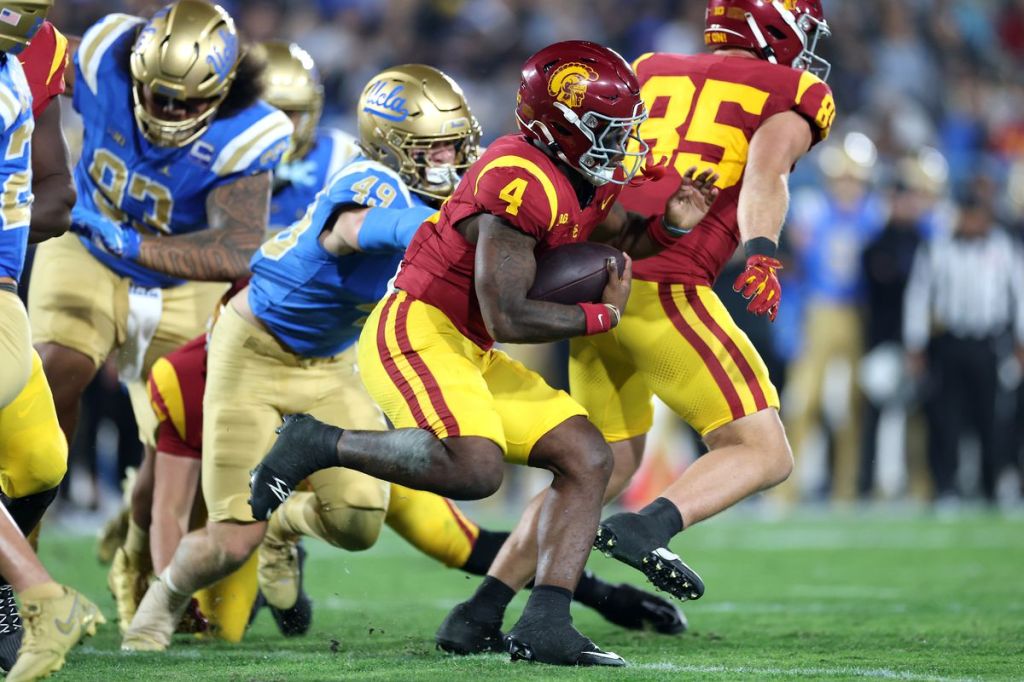
The Big Ten Conference continues to evolve as one of the premier leagues in college football, blending its Midwestern roots with newfound West Coast flair following its latest round of expansion. With the additions of USC, UCLA, Oregon, and Washington, the B1G now stretches from coast to coast—offering not just broader recruiting pipelines and national exposure, but also more marquee matchups and media value than ever before. These new member schools are joining a group that consistently ranks among the nation’s leaders in revenue, fan attendance, and NFL Draft production, while its academic reputation and athletic facilities help attract top-tier talent across the board. As the 2025 season approaches, the Big Ten stands poised to remain a central player in shaping the College Football Playoff race. In this article, I will reveal the final part of my B1G predictions and previews consisting of the following teams: UCLA, USC, Washington, and Wisconsin.
—————————————————————————————————————————————
UCLA Bruins
8/30 – vs. Utah – Win
9/6 – @ UNLV – Loss
9/12 – vs. New Mexico – Win
9/20 – BYE
9/27 – @ Northwestern – Win
10/4 – vs. Penn State – Loss
10/11 – @ Michigan State – Loss
10/18 – vs. Maryland – Win
10/25 – @ Indiana – Loss
11/1 – BYE
11/8 – vs. Nebraska – Win
11/15 – @ Ohio State – Loss
11/22 – vs. Washington – Win
11/29 – @ USC – Loss
Final Record: 6-6 (4-5)
Year Two of the DeShaun Foster era at UCLA brings both pressure and opportunity as the Bruins look to rebound from a disappointing 2024 campaign. While Foster deserves some leeway after inheriting a roster in transition and facing a far more demanding conference slate than Chip Kelly ever did in the Pac-12, the expectations are clear: get back to a bowl and prove this program is heading in the right direction under his leadership.
To help guide that turnaround, Foster made a major shake-up on offense, replacing Eric Bieniemy with former Indiana quarterbacks coach Tino Sunseri and landing one of the biggest prizes in the transfer portal—former Tennessee quarterback Nico Iamaleava. He’ll be joined in the backfield by Cal transfer Jaivian Thomas, who’s expected to fill the void left by TJ Harden’s transfer to SMU. Iamaleava will work with a young, developing group of pass-catchers, including breakout candidate Kwazi Gilmer and former Cal slot receiver Mikey Matthews. Notre Dame transfer Rico Flores Jr. adds intrigue at receiver as well, though depth and tight end production remain question marks. Still, the offensive line should be a strength with three high-upside transfer additions: Kentucky’s Courtland Ford, Florida State’s Julian Armella, and Oklahoma’s Eugene Brooks.
On defense, coordinator Ikaika Malloe helped this unit exceed expectations last year despite losing D’Anton Lynn to USC, but a serious reload is now required. The Bruins lose nearly all of their front-seven contributors, especially at linebacker with Carson Schwesinger and Kain Medrano gone. That puts pressure on returners Jalen Woods and JonJon Vaughns, as well as Louisville transfer Ben Perry, to step up quickly. In the trenches, the losses of Oluwafemi Oladejo and Jay Toia sting, and younger pieces like Devin Aupiu and Siale Taupaki will be counted on to emerge. Most of the defensive help from the portal arrives in the secondary, where Ole Miss safety Key Lawrence and Oregon State corner Croix Stewart headline a group that must help cover for a potentially inconsistent pass rush.
UCLA opens the season with a tricky non-conference test against Utah at home before heading to Las Vegas to take on UNLV. They avoid B1G heavyweights Oregon, Michigan, and Illinois, but a critical early showdown with Penn State at the Rose Bowl looms large. The real test, however, will be in the back half of the season with a brutal five-game stretch that includes road trips to Indiana, Ohio State, and USC, along with home games against Washington and Nebraska.
If Foster can rally his team down the stretch and steal a couple of those late matchups, UCLA should find itself back in the postseason—and more importantly, he’ll have a real case to continue building this program in his image.
—————————————————————————————————————————————
USC Trojans
8/30 – vs. Missouri State – Win
9/6 – vs. Georgia Southern – Win
9/13 – @ Purdue – Win
9/20 – vs. Michigan State – Win
9/27 – @ Illinois – Loss
10/4 – BYE
10/11 – vs. Michigan – Win
10/18 – @ Notre Dame – Loss
10/25 – BYE
11/1 – @ Nebraska – Loss
11/7 – vs. Northwestern – Win
11/15 – vs. Iowa – Win
11/22 – @ Oregon – Loss
11/29 – vs. UCLA – Win
Final Record: 8-4 (6-3)
USC enters Year Four of the Lincoln Riley era and its second season in the B1G with renewed optimism—but also mounting pressure. After an underwhelming first run through the B1G gauntlet, Trojan fans are eager to see if Riley’s revamped roster can prove it belongs among the league’s elite. The spotlight is squarely on a program that, despite its prestige, still has something to prove in its new environment.
On offense, Riley turns to Luke Huard—previously a rising name in quarterback development—to take over playcalling duties in hopes of reigniting the explosiveness that defined Riley’s past teams. With 2024 Holiday Bowl MVP Miller Moss transferring to Louisville, the quarterback battle will be one of USC’s biggest storylines entering the season. Redshirt sophomore Jayden Maiava, who saw meaningful snaps last fall, will face competition from Utah transfer Sam Huard and five-star true freshman Husan Longstreet. The backfield also undergoes a reshuffle, with NFL-bound Woody Marks and Texas Tech-bound Quinten Joyner both gone. That leaves New Mexico transfer Eli Sanders, JUCO standout Waymond Jordan, and sophomore Bryan Jackson to form a committee. At receiver, the loss of stars like Zachariah Branch, Kyron Hudson, and Duce Robinson leaves the group with question marks—but also opportunity. Makai Lemon and Ja’Kobi Lane will be counted on to take major steps forward, while Boise State transfer Prince Strachan brings size and red-zone potential. Tight ends Lake McRee and Walker Lyons offer familiarity and stability in the passing game. The offensive line also sees turnover, but the additions of Purdue’s DJ Wingfield and Syracuse’s J’Onre Reed aim to fill the gaps left by Jonah Monheim and Emmanuel Pregnon.
Defensively, USC finally found a rhythm last year under coordinator D’Anton Lynn, and 2025 could be even better. Although top tacklers Mason Cobb and Ethan Mascarenas-Arnold have moved on from the linebacker room, the return of a fully healthy Eric Gentry—paired with breakout candidate Desman Stephens II—gives the group a strong foundation. The defensive line boasts legitimate depth and talent with returners Braylan Shelby, Anthony Lucas, and Kameryn Fountain flanking the edges, while the interior welcomes high-upside transfers Keeshawn Silver out of Kentucky and Jamaal Jarrett out of Georgia. Freshman phenom Jahkeem Stewart is also a name to watch. In the secondary, NC State transfer Bishop Fitzgerald steps in alongside returning safety Kamari Ramsey, and former San José State standout DJ Harvey adds experience at corner.
While USC’s schedule may not be packed with headline-grabbing matchups every week, it still presents a number of physical and high-stakes challenges. The Trojans will face just one conference opponent from last season’s College Football Playoff field—Oregon—on the road in a pivotal late-season clash that’s followed immediately by the crosstown showdown against UCLA for the Victory Bell. Elsewhere, they’ll be tested by a home matchup with Michigan and tough road trips to Illinois, Notre Dame, and Nebraska—each of which will challenge USC’s toughness in the trenches and reveal just how far Lincoln Riley’s squad has come in adjusting to the B1G’s physical brand of football.
Still, with modest improvements on both sides of the ball and a few key additions from the portal, this USC squad has the tools to take a step forward. While a Big Ten title may be out of reach for now, don’t be surprised if the Trojans crack the Top 25 by season’s end as Lincoln Riley continues to mold the program into a better fit for its new surroundings.
—————————————————————————————————————————————
Washington Huskies
8/30 – vs. Colorado State – Win
9/6 – vs. UC Davis – Win
9/13 – BYE
9/20 – @ Washington State – Win
9/27 – vs. Ohio State – Loss
10/4 – @ Maryland – Win
10/10 – vs. Rutgers – Win
10/18 – @ Michigan – Loss
10/25 – vs. Illinois – Loss
11/1 – BYE
11/8 – @ Wisconsin – Loss
11/15 – vs. Purdue – Win
11/22 – @ UCLA – Loss
11/29 – vs. Oregon – Win
Final Record: 7-5 (4-5)
After a magical 2023 campaign that ended with a trip to the National Championship Game, Washington’s swift fall to a 6-7 record in 2024 served as a harsh reality check. The departure of Kalen DeBoer to Alabama left a leadership void that Jedd Fisch, fresh off his success at Arizona, was brought in to fill. Now entering his second year at the helm, Fisch and his Huskies look to rebound behind a reshaped staff that includes newly promoted offensive coordinator Jimmie Dougherty and former Purdue head coach Ryan Walters taking over the defense.
Sophomore quarterback Demond Williams Jr. flashed serious potential in his final two starts last season and is now the clear face of the offense. A dynamic runner with an improving arm, Williams will look to build off a 374-yard passing performance in the Sun Bowl and elevate Washington’s attack in the post-Penix era. Helping him in the backfield is explosive 1,000-yard rusher Jonah Coleman, a returning leader who offers both production and toughness. While top targets Giles Jackson and Jeremiah Hunter are gone, the Huskies return Denzel Boston and add Penn State transfer Omari Evans, forming a promising pass-catching duo. The offensive line will be under the microscope after a shaky 2024, but key additions like Kansas State tackle Carver Willis and Oklahoma’s Geirean Hatchett should help stabilize things. Tight ends will be expected to do more than stretch the field—they’ll need to be consistent blockers to support a balanced offense.
Defensively, Washington will need a serious step forward after posting just 20 sacks last season without 2023 pillars like Bralen Trice, Zion Tupuola-Fetui, and Edefuan Ulofoshio. There’s potential up front with returning end Isaiah Ward and Arizona transfer Ta’ita’i Uiagalelei, but the interior must show more bite if this unit is to improve. The linebacker corps, while hit hard by the departures of Carson Bruener and Alphonzo Tuputala, welcomes several key transfers—including Washington State’s Taariq Al-Uqdah, UCF’s Xe’ree Alexander, and former Arizona star Jacob Manu, who’s back after missing last season with an injury. The real strength of this defense could be the secondary. Despite already finishing second nationally in pass defense in 2024, the group looks even more formidable this year with the return of lockdown corner Ephesians Prysock and the additions of Arizona’s Tacario Davis, FIU’s CJ Christian, and Northern Arizona’s Alex McLaughlin.
Even though an easy nonconference schedule should help them, Washington’s conference slate won’t make things easy. They host Ohio State early in a major litmus test, then head to Ann Arbor for a clash with Michigan before returning home to face both of Ryan Walters’ former teams—Illinois and Purdue. A Senior Day showdown with Oregon adds extra weight to their finish. They’ll also square off early with rival Washington State in the annual Apple Cup, which remains a point of pride.
This Huskies team may not be built to repeat its 2023 glory, but Year Two under Fisch has the ingredients for modest improvement. Expect them to be more competitive, steal a big win or two, and begin carving out their identity in the new-look B1G.
—————————————————————————————————————————————
Wisconsin Badgers
8/28 – vs. Miami (OH) – Win
9/6 – vs. Middle Tennessee – Win
9/13 – @ Alabama – Loss
9/20 – vs. Maryland – Win
9/27 – BYE
10/4 – @ Michigan – Loss
10/11 – vs. Iowa – Win
10/18 – vs. Ohio State – Loss
10/25 – @ Oregon – Loss
11/1 – BYE
11/8 – vs. Washington – Win
11/15 – @ Indiana – Loss
11/22 – vs. Illinois – Loss
11/29 – @ Minnesota – Win
Final Record: 6-6 (4-5)
Luke Fickell’s arrival in Madison was supposed to signal a new era for Wisconsin football, but after two underwhelming seasons, the pressure is mounting. Since making Cincinnati a College Football Playoff contender, Fickell has yet to replicate that success with the Badgers, who just wrapped up their first losing season since 2001 and haven’t surpassed seven wins in a single campaign since 2021. Entering 2025, Fickell faces a pivotal year where improvement is a must—not a hope.
Part of the challenge is starting over at quarterback after Braedyn Locke and Tyler Van Dyke transferred to Arizona and SMU, respectively. New offensive coordinator Jeff Grimes, formerly at Baylor, takes over for Phil Longo and brings a more physical, run-heavy approach. He’ll have to choose between two new signal-callers from the portal: Maryland transfer Billy Edwards Jr. and San Diego State freshman Danny O’Neil, a promising but inexperienced option. Replacing running back Tawee Walker will be crucial—either Cade Yacamelli or freshman Darrion Dupree will need to rise to the occasion for Wisconsin to reclaim its traditional ground-and-pound identity. At receiver, Ohio State transfer Jayden Ballard is expected to be a big-play threat alongside returners Vinny Anthony II and Trech Kekahuna following Will Pauling’s departure to Notre Dame. Former Ball State tight end Tanner Koziol was originally transferring to Madison, but now that he’s chosen to go to Houston instead, Tucker Ashcraft’s size could help out in blocking with an offensive line that, while having four starters back, loses tackle Kevin Heywood to a season-ending injury.
On the defensive side, Mike Tressel is back in full control following Alex Grinch’s short-lived tenure. The unit showed flashes last year but lacked consistency, especially in generating pressure. With Elijah Hills departing, three transfer additions along the defensive front will need to step in and elevate a group that was far too quiet in big moments. The linebacker corps, however, looks to be a strength. Christian Alliegro returns after tying for the team lead in sacks, Tackett Curtis is back healthy, and Louisville transfer Mason Reiger brings disruptive production with five sacks and six TFLs in 2023. In the secondary, the losses of NFL-bound Hunter Wohler and new Miami corner Xavier Lucas sting, but Wisconsin will still have depth there and will lean on returning starters Nyzier Fourqurean and Preston Zachman, both of whom must help generate more turnovers after the team tallied just four interceptions all last season.
While there’s hope that each side of the ball will be somewhat better, they run into one of the toughest schedules in the B1G. After a tune-up stretch early on, the Badgers head to Tuscaloosa in mid-September to face Alabama. From there, they run through a brutal gauntlet that includes a road matchup at Michigan, back-to-back home games against Iowa and Ohio State, and another trip to the west coast at Oregon. Even after all of the chaos in the middle of the season, they’ll still have a late-season road trip to Indiana and a visit from Illinois also on the docket. Missing Penn State is a small relief, but it doesn’t lighten the load much.
Still, with some upgraded personnel and a fresh approach on both sides of the ball, Wisconsin has enough to edge its way back to bowl eligibility. It may not be the breakthrough season fans hoped for when Fickell was hired, but it could be just enough to steady the program and buy more time for a true turnaround.


 The Clutch Index
Leave a comment